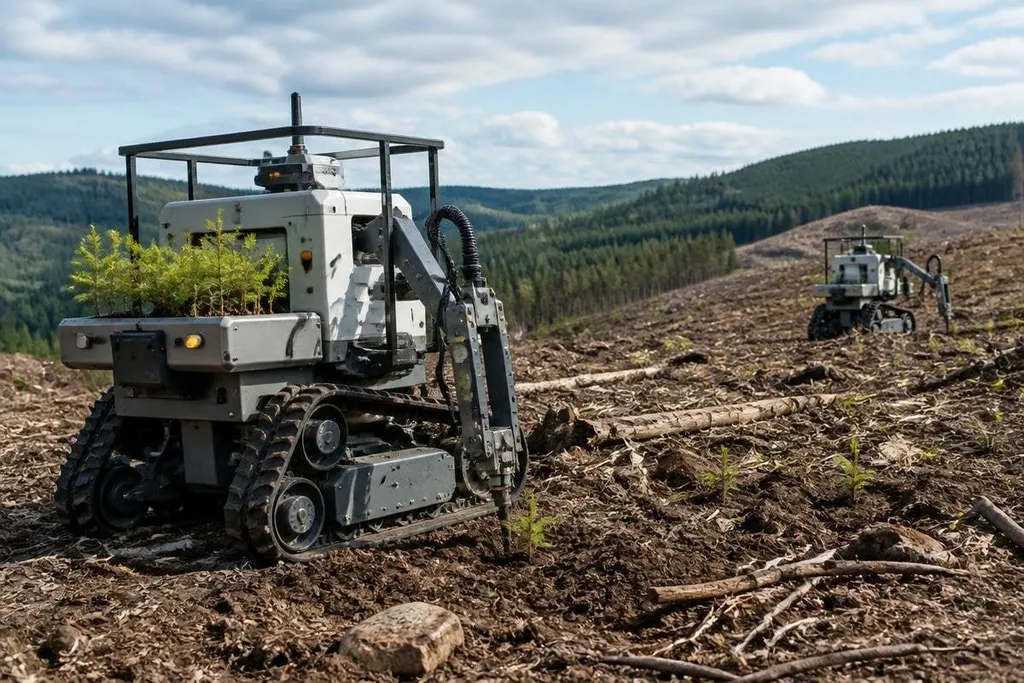
Planting millions of trees means repeating the same job across rough ground, changing weather, and many planting sites. Robots could help by mapping each site, placing seedlings at set points, and recording what happened after each planting.
Quick read
- Site maps tell the robot where planting will work.
- A planting tool must protect the seedling roots.
- Aftercare may matter as much as the first planting pass.
The robot starts with a map
A tree-planting robot would need a digital map before it carries a seedling. Cameras, satellite positioning, and LiDAR could help it mark slopes, rocks, paths, old roots, and areas where water collects.
That map changes the job from placing trees at fixed gaps to choosing spots that fit the ground. The robot could then plan a route that avoids steep sections or sends a human crew to places the wheels cannot reach.
The map also creates a record. Each planted seedling could have a position, planting date, and condition attached to it.
That information would help a land manager return to weak areas instead of searching an entire site by hand.
Planting is a chain of small jobs
A planting robot does more than push a seedling into soil. It has to reach the spot, prepare a hole, place the roots at a safe depth, close the soil, and leave the stem upright.
The tool at the end of the arm matters most. It needs to hold a young tree without crushing the stem or stripping soil from the roots. The hole must fit the seedling, while the closing step needs enough force to keep the roots in contact with damp soil.
Soil changes from one metre to the next. With resistance sensing, the machine could pause, adjust the hole, or send the location to a person for a decision.
That last option matters. A failed planting attempt costs a seedling, machine time, and a return visit. Recording failure may do more useful work than hiding it behind a clean count.
Millions of trees need more than one planting pass
Planting ends when the seedling enters the ground. The work after that may include watering, checking damage, clearing competing plants, and replacing dead trees.
The system could return along the same mapped route and inspect each planting point with a camera. It might spot a missing stem or a dry patch, but a camera cannot fix every cause of failure. People may still need to bring water, repair fencing, or change the planting plan.
Planting millions of trees turns a route plan into a field service problem. Robot24 can help you compare reports on outdoor robots by the soil, weather, battery time, and operator work recorded in each trial. Those details matter here because a machine that plants well for an hour may still need people to keep the project running across a large site.
The work also needs a steady supply of seedlings in matching trays, spare parts near the site, and a safe way to move people around the robot. A planting system can place many trees on paper while losing time to transport, blocked routes, or tool changes.
Where the plan can fail
Forests and damaged land rarely offer a clean test area. Wet soil can trap wheels. Dry soil can resist the planting tool. Tall grass can hide rocks, while steep ground can make a heavy robot unsafe to recover by hand.
Weather adds another limit. Rain affects traction and soil condition. Heat changes how long batteries and people can work. Smoke, dust, and low light can also reduce what cameras can see.
I’d back robots for mapped planting sites with repeatable ground conditions, not as a replacement for every field crew. Human workers remain better suited to quick decisions in broken terrain and places the robot has not seen before.
The strongest case may be a mixed crew. Robots handle long, repeated sections. People set the route, check the first plantings, clear faults, and work in areas that need judgment. That arrangement gives the robot a narrow job it can measure.
A practical test before buying
A land manager can check whether a planting robot fits the site by asking:
- Ground first: Can the robot reach the planting zones without unsafe slopes, deep mud, or hidden obstacles?
- Seedling fit: Does the tool support the root shape and tray used by the nursery?
- Failure record: Can the system mark skipped, damaged, or uncertain planting points?
- Return visit: Can the robot follow the same map for inspection and watering work?
- Human backup: How fast can a person reach a blocked robot or failed tool?
- Cost record: Does the site measure seedlings planted, failed attempts, travel time, and service work separately?
Those checks turn a tree-planting idea into a field test with results that another site can compare. They also show where robots may save labor and where they may add another machine for people to manage.
The first proof will be a site record that links planted trees to survival checks, not a video of a robot placing seedlings. Until that record exists across difficult ground, millions of planted trees remain a target rather than a result.